Sacred Spaces, Life-Saving Conversations: How Faith Communities Are Quietly Becoming America's Most Trusted Health Checkpoints
The Room Where Trust Already Exists
Every Sunday morning, Wednesday evening, and Friday night, something remarkable happens in neighborhoods across the United States. Millions of people — many of them elderly, uninsured, or deeply skeptical of institutional medicine — gather voluntarily in a shared space, guided by a figure they trust unconditionally, surrounded by people who know their names.
They are not in a clinic. They are in a church, a mosque, a synagogue, or a temple.
For decades, public health officials have wrestled with a stubborn problem: how do you reach the Americans most at risk for preventable disease when those same Americans are least likely to walk through a doctor's office door? The answer, it turns out, may have been sitting in plain sight in every zip code in the country — including the ones that lack a single primary care physician.
Faith communities represent one of the largest, most consistent, and most trusted gathering infrastructures in American civic life. According to Gallup, roughly half of all American adults report attending religious services at least occasionally, with attendance concentrated among populations — older adults, Black and Hispanic Americans, low-income households — who face disproportionate burdens from chronic and late-detected disease. Yet the vast majority of congregations have no formal mechanism for health awareness, symptom education, or early screening.
That is beginning to change.
What Faith-Based Health Ministries Are Actually Doing
The faith-based health ministry model is not new, but it is growing with new urgency. At its core, the model embeds trained health advocates — often registered nurses, community health workers, or certified health coaches who are also congregation members — directly into the life of a religious community. These individuals are not outsiders arriving with clipboards. They are deacons, choir members, and longtime parishioners who happen to hold clinical credentials.
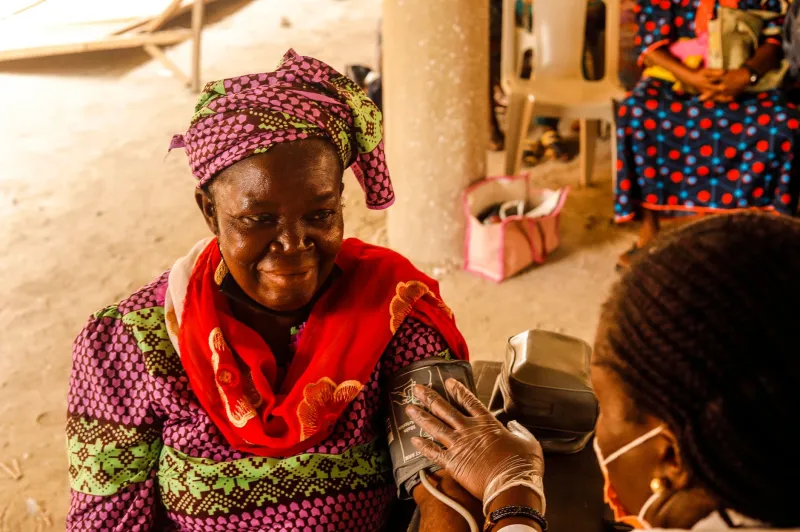
In practical terms, this means blood pressure cuffs appearing in fellowship halls after Sunday services. It means a brief announcement from a trusted nurse before a congregation dismisses, reminding members over 45 that colorectal cancer screening is now a simple at-home test. It means a quiet conversation in a church parking lot where a health volunteer notices that a longtime member's ankles are swollen and her speech is slightly slurred — and connects her to care before a stroke becomes a catastrophe.
Programs like the Black Church Health Initiative, the Islamic Medical Association of North America's community outreach efforts, and Catholic Health Initiatives' parish nurse networks have documented exactly these kinds of outcomes. Congregants who had not seen a physician in years were identified with uncontrolled hypertension. Individuals who dismissed persistent fatigue as a spiritual burden were screened and found to have Type 2 diabetes. Women who feared mammograms — or simply could not afford them — were connected to free screening services through relationships built in a pew.
The conditions being caught are not obscure. They are the leading drivers of preventable death in the United States: cardiovascular disease, diabetes, colorectal cancer, cervical cancer, and chronic kidney disease. All of them respond dramatically better to treatment when identified early. All of them are disproportionately fatal in the communities where faith institutions hold the deepest social roots.
Why Trust Is the Diagnostic Tool No Hospital Can Manufacture
Public health researchers have long understood that medical distrust is not irrational. It is, in many communities, historically earned. The legacy of the Tuskegee syphilis study, documented disparities in pain management, and lived experiences of dismissal and misdiagnosis have produced a well-founded wariness toward formal healthcare institutions in Black, Indigenous, and many immigrant communities.
Faith communities do not carry that institutional baggage. A pastor who recommends that a congregation member check their blood sugar is not perceived as a representative of a system that has historically failed them. A nurse who volunteers at a mosque health fair is received as a neighbor, not a bureaucrat. That relational credibility is extraordinarily difficult to replicate and virtually impossible to purchase.
Research published in health equity journals consistently finds that health information delivered through trusted community messengers — including faith leaders — produces higher rates of screening uptake, follow-through on referrals, and sustained behavior change than the same information delivered through clinical or governmental channels. When a congregation member hears a health message from their spiritual leader, it carries moral weight that a brochure in a waiting room simply cannot replicate.
This is not a peripheral consideration. It is the central mechanism by which faith-based health interventions succeed where other outreach efforts fail.
The Gaps That Still Exist — and Why They Matter
Despite documented success, faith-based health ministry remains dramatically underscaled. The majority of American congregations — particularly smaller ones in rural areas and low-income urban neighborhoods — have no health ministry at all. Where programs do exist, they often depend on a single volunteer whose departure can dismantle years of built infrastructure. Funding is inconsistent, training is uneven, and formal partnerships with local health departments or hospital systems remain the exception rather than the rule.
The consequences of this gap are measurable. Communities with the highest rates of late-stage cancer diagnosis, uncontrolled hypertension, and diabetes-related amputations are frequently the same communities where faith participation is highest and formal healthcare access is lowest. The infrastructure to reach these individuals exists. The health literacy programming and screening connectivity that would make that infrastructure clinically meaningful largely does not.
State and local health departments have begun to recognize this mismatch. A growing number of jurisdictions are funding community health worker programs that specifically partner with congregations, training volunteers in basic screening protocols, symptom recognition, and care navigation. The Centers for Disease Control and Prevention has supported faith-based health initiatives as part of its chronic disease prevention framework. But adoption remains inconsistent and funding remains fragile.
What a Scaled Model Could Look Like
The vision articulated by advocates in this space is not complicated. It does not require converting sanctuaries into clinics or asking clergy to practice medicine. It requires three things: trained health advocates embedded within congregations, reliable access to basic screening tools and referral pathways, and sustained partnerships between faith institutions and local health systems.
In that model, a congregation of 300 people becomes a chronic disease surveillance network. A health fair held four times a year becomes an early detection event that catches conditions before they become crises. A pastor's announcement before dismissal becomes a public health intervention that reaches people no billboard or mailer ever will.
The technology required is minimal. A blood pressure cuff, a fingerstick glucose monitor, and a trained volunteer can identify two of the most prevalent and most dangerous undiagnosed conditions in the country. Colorectal cancer screening kits can be distributed and explained in a fellowship hall. Skin cancer awareness cards can be placed in bulletins. Cervical and breast cancer screening reminders can be delivered by someone whose voice a congregation member has trusted for twenty years.
The Intervention Hiding in Plain Sight
America has spent decades and billions of dollars trying to solve the early detection problem. It has built screening programs, launched awareness campaigns, and trained armies of healthcare workers. And yet millions of Americans — particularly those in the communities most devastated by preventable disease — remain unreached.
The waiting room that never fills is not in a hospital. It is in a sanctuary. It is full every week. The people in it trust the institution that brought them there. They are ready to be reached.
The question is whether the public health community, health systems, and policymakers are prepared to meet them where they already are — before a manageable condition becomes an emergency, and before an emergency becomes a death that no one had to accept.